
CitizENS is a new series spotlighting the people building, improving, and shaping ENS, and the work happening behind the scenes to move the protocol forward.
When we spoke, Simon Alexander-Adams had an installation opening in three days. He'd worked out what he could finish before then; once people arrived, he'd have to call it done. "At least for this iteration," he added.
Simon, also known as Polyhop, is the artist behind the ENSv2 commemorative collection. You may already have revealed your card and looked up what its traits mean. But the work that led him here extends well beyond this collection, through music, interactive installations, and more than eight years of daily generative sketches.
That much practice hasn't made finishing automatic. It has given him plenty of opportunities to get better at it.
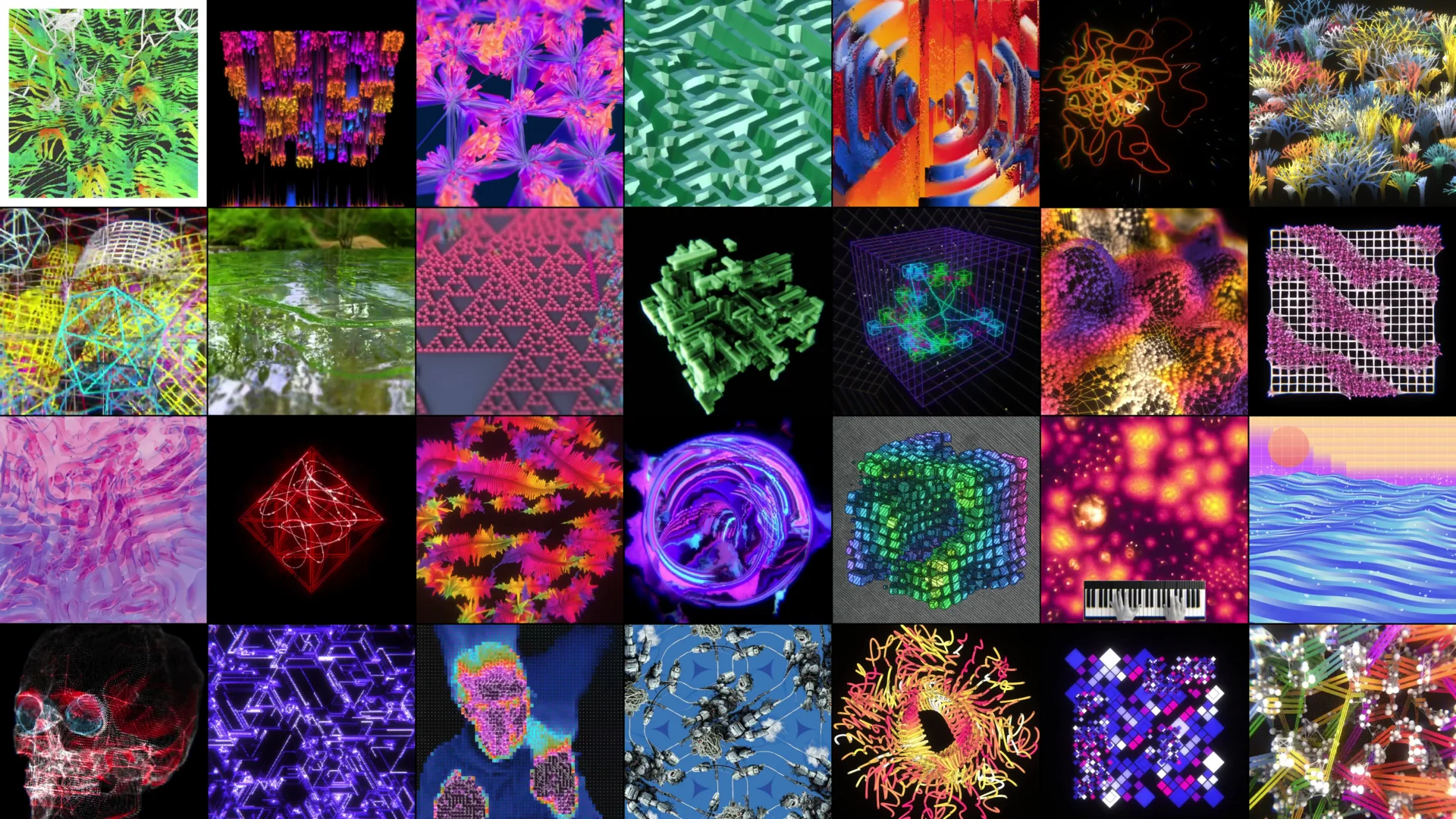
Simon was already a musician and visual artist when he began looking for ways to bring those interests into the same work. At the University of Michigan, he experimented with designing new musical instruments, building interactive installations, and directing multimedia performances. Working with software opened up possibilities such as visuals that responded to music or changed with someone's movements.
He started with creative coding tools Max and Processing before his mentor and friend Carlos Garcia introduced him to TouchDesigner. After university, Simon sought out installation projects that would help him develop those skills. But he still wasn't spending as much time experimenting as he wanted.
In April 2018, he decided to try sharing a new generative sketch every day for a month. A year sounded daunting. A month seemed manageable. In his account of that first year, he describes finding the routine easier to sustain than he'd expected, so he kept going.
He kept the rules flexible: he could prepare sketches ahead of time and revisit earlier ideas. The routine gave him time to experiment in TouchDesigner without waiting for a commission, and made sharing part of the practice. There would be another chance to work on an idea tomorrow.
Music was a long-running commitment, too: he played with the art-rock band saajtak for about a decade. Before our conversation reached ENS, we were talking about a month he spent studying Carnatic music in India. As a pianist and composer, he was drawn to its cyclical rhythms, even though percussion wasn't his usual territory.
Music also shapes how he talks about visual work. While discussing what makes an artwork worth sharing, he reached for the experience of performing onstage: "Why should I as a listener care if you don't care?" Whatever the medium, he needs to believe in what he's putting in front of people.
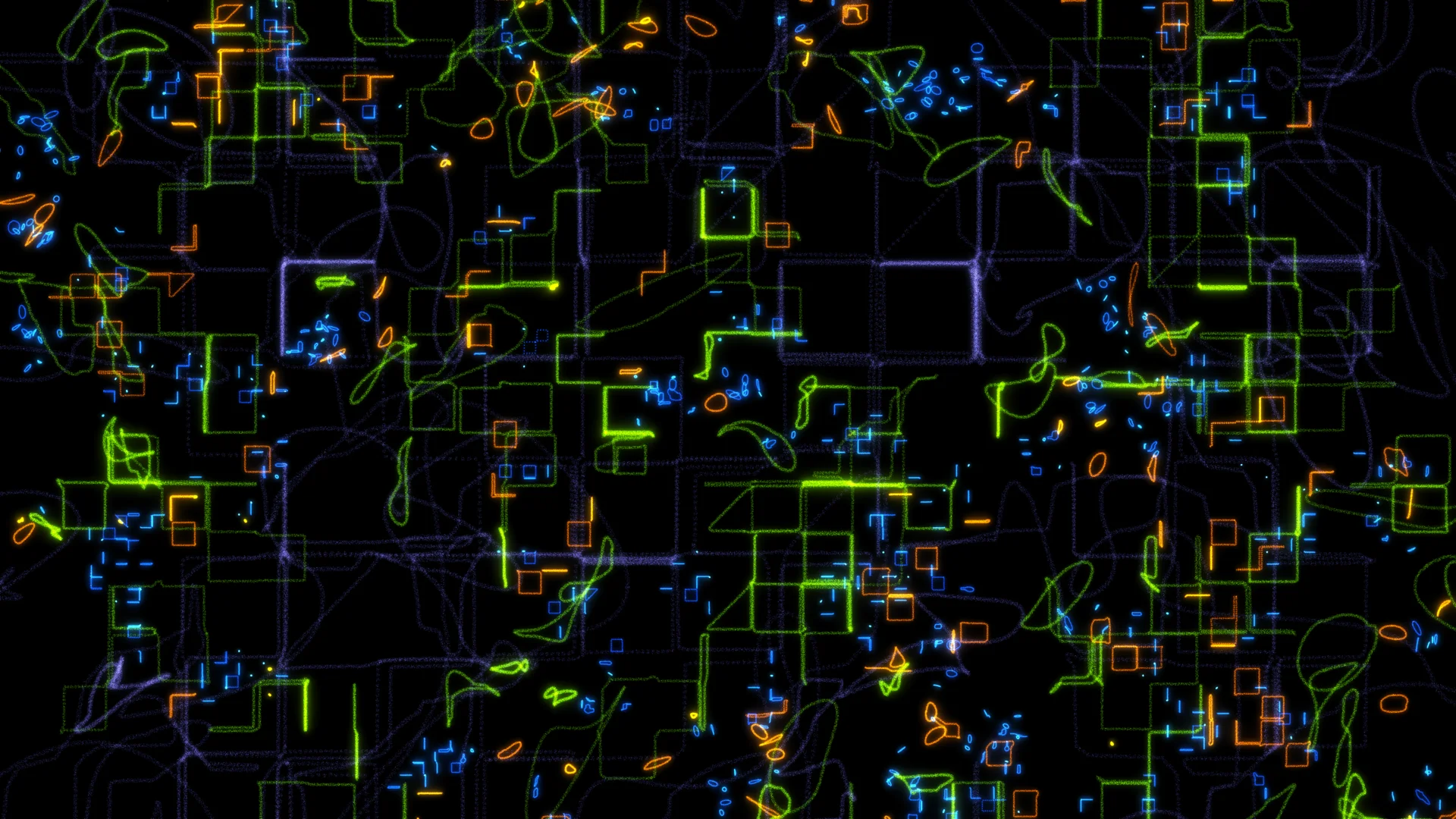
Generative art gives that question another dimension. Simon designs systems that determine aspects of the finished work, choosing which decisions to make himself and where to allow variation. He likes a phrase he encountered in artist Anders Hoff's writing: "shepherding randomness."
His choices determine what the system can produce and what holds the different outputs together. The work is in deciding how much freedom to leave.
His installation Silhouettes I–IV offers a physical example. It uses the outlines of visitors' bodies to let them interact with visual simulations. Their movements feed into flowing, smoke-like effects and shifting patterns. Someone walking into the room becomes part of what happens on the screen.
From 2020 through 2024, he worked full time at ARTECHOUSE, focusing on software for large-scale installations. Working with the studio team, he contributed to Beyond the Light with NASA, Life of a Neuron with the Society for Neuroscience, and Twilight Zone with WHOI.
He went independent around 2025. He's since been expanding his TouchDesigner tutorials on YouTube and Patreon, working on local exhibits and installations in Detroit, and developing a new audiovisual project.
ENS offered a different set of inputs. Simon wasn't especially familiar with the protocol when the team approached him, but the prospect of making artwork from someone's history caught his attention. The collection would carry information that already mattered to its recipient.
That gave him a challenge beyond producing attractive variations: how could those differences mean something?
Some translations were straightforward. More names could mean a denser composition. Other choices needed a less literal approach, such as giving earlier eras increasingly complex palettes, then breaking established color rules for the earliest histories.
The team also shared ENS's visual identity, which Simon drew on without wanting it to dominate the work. "I didn't want it to feel heavy-handed, like, 'Oh, this is a brand piece,'" he said.
The card edges were a more stubborn problem. Simon and the ENS team wanted visible wear to feel desirable. It would be easy to make a card look damaged; making it feel like a treasured collectible took more consideration.
The team looked at a worn Pokémon card, examining how foil showed through the surface. Simon brought that idea into the collection's holographic treatments, letting wear expose another layer along the edges. Circuit-like patterns add details that are easy to miss until you look closely.
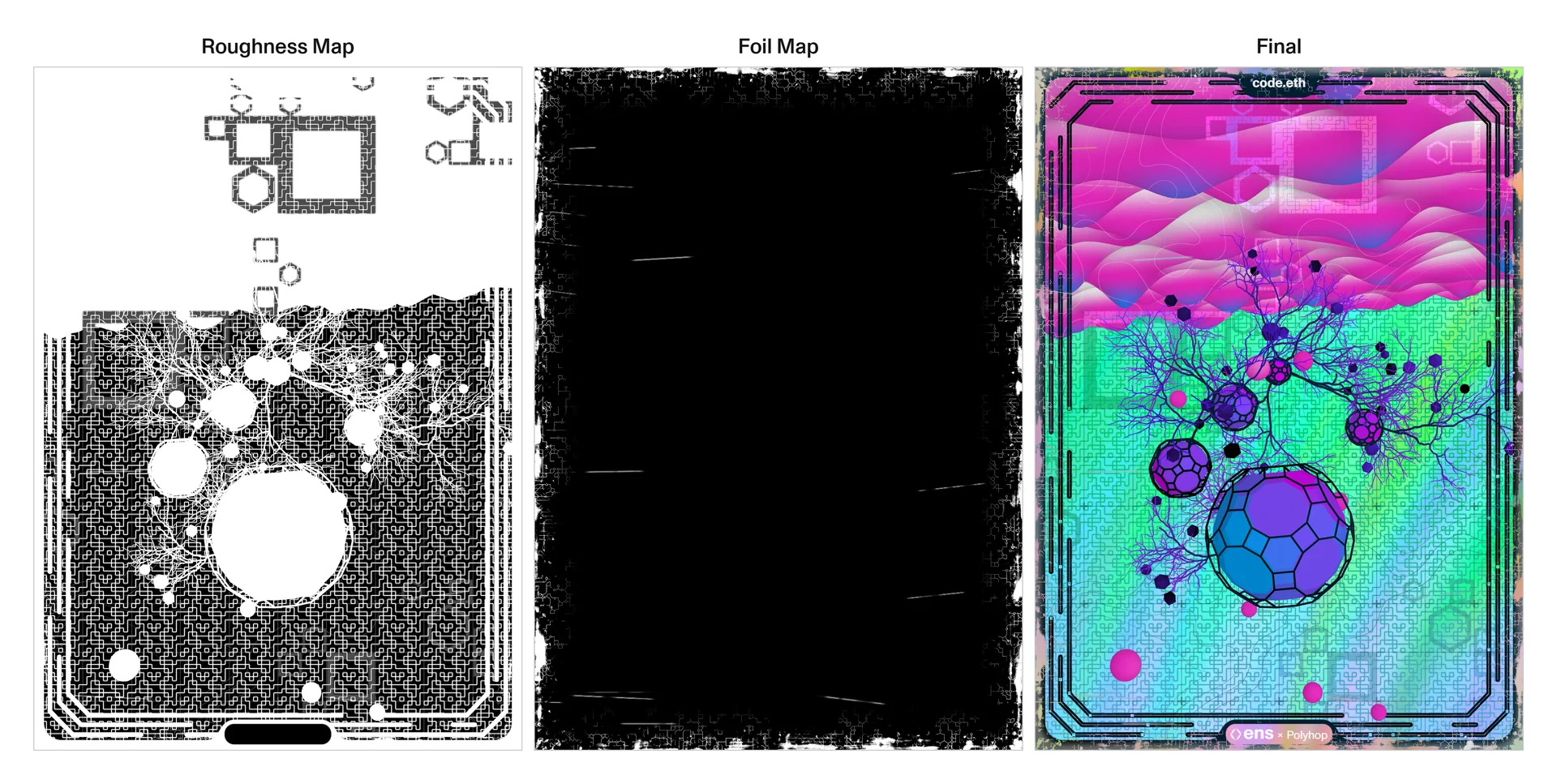
Elsewhere, he thought about restraint. Background patterns needed to remain in the background. A person spending time with the card could discover them without being distracted from the main composition.
He compared that work to sound design in a film: an element can contribute enormously without being the first thing you notice.
For all his interest in giving systems freedom, Simon was deliberate about controlling this collection. There were already many inputs to accommodate. Leaving too much open could produce combinations he wouldn't want to release; restricting everything would leave too little room for variation.
"You're not going to create a foolproof system," he told us. "But I also think that's part of the charm in some ways."
Knowing that doesn't stop him seeing what he'd change. With more experience, his idea of the best work he could make keeps moving ahead of him. Chase that imagined version indefinitely, he says, and "you'll never release anything."
The daily sketches give him regular practice at making that decision. An installation opening gives him a deadline he can't negotiate with. Either way, at some point other people need to be allowed to see the work.
What happens then is something Simon doesn't try to prescribe. He isn't setting out to make every viewer feel the same thing. He works toward something he believes in, then leaves room for reactions he couldn't have planned.
"Usually they'll find things that I don't see or expect," he said.
With the ENS collection, the people seeing his work also supplied part of its material. Simon spent his time thinking about color, composition, and how to make an edge look worn. You bring your own associations with the name on it, and the time you've spent using it.
He could build a system that responds to that history. What it means to you was always going to be yours to decide.