
ENS Labs and GLEIF are exploring how to associate ENS names with verifiable Legal Entity Identifiers (vLEIs), so applications can confirm the organization behind an onchain name. The approach is still in development, with a proposed ENS standard intended to give institutions a consistent way to verify counterparties and organizational accounts.
As more organizations and institutions move onchain, foundational questions surface: Are counterparties truly who they claim to be?
These essential problems sparked the collaboration between ENS Labs and the Global Legal Entity Identifier Foundation (GLEIF) to create a path for verifiable organizational identity onchain by leveraging the Legal Entity Identifier (LEI) and the verifiable LEIs (vLEIs) within ENS profiles. The work is still in development while we explore how an ENS name can provide a persistent, onchain reference for an organization, with GLEIF providing the globally standardized legal entity identity infrastructure underpinning the LEI and vLEI .
An LEI is a unique, globally standardized identifier for a legal entity.
LEIs are instrumental to embedding trust in financial transactions. A bank may know which account a payment is being sent to, while still needing a reliable way to identify the company behind that account. LEIs give companies a standardized identifier that uniquely identifies the legal entity no matter the account or financial infrastructure. The vLEI builds on the LEI by making organizational identity computationally verifiable, including the authority of people acting on an organization's behalf.
As organizations move onchain, the need for verifiable digital identifiers grows. A collaboration between GLEIF, which maintains the Global LEI System and the vLEI ecosystem, and ENS, the open naming layer, became a natural fit. An ENS name can point to addresses and other information used by wallets and apps on many networks, providing organizations one persistent name wherever they go.
Connecting an ENS name to a vLEI gives counterparties a way to verify the organizational identity behind that name, and addresses the question: is my counterparty truly who they claim to be?
Recently, GLEIF has been drafting a method-agnostic approach for associating external identifiers, such as ENS names, with an organization's vLEI, together with an ENS-specific profile of it. The next step is to define the ENS implementation through an ENS Improvement Proposal (ENSIP).
ENSIPs are public technical proposals used to define standards for the ENS ecosystem. They give partners a common specification to implement without leaving each integration to define its own approach.
The proposed ENSIP would focus on the ENS side of the association, while the issuance, governance and verification of vLEI credentials remain within the GLEIF vLEI governance framework.
Naming systems make organizations easier to find. A legal identity framework provides verifiable information about the organization behind that name. Through the proposed approach, applications and counterparties can establish greater confidence in an organization's onchain identity through a signed association between an ENS name and corresponding vLEI.
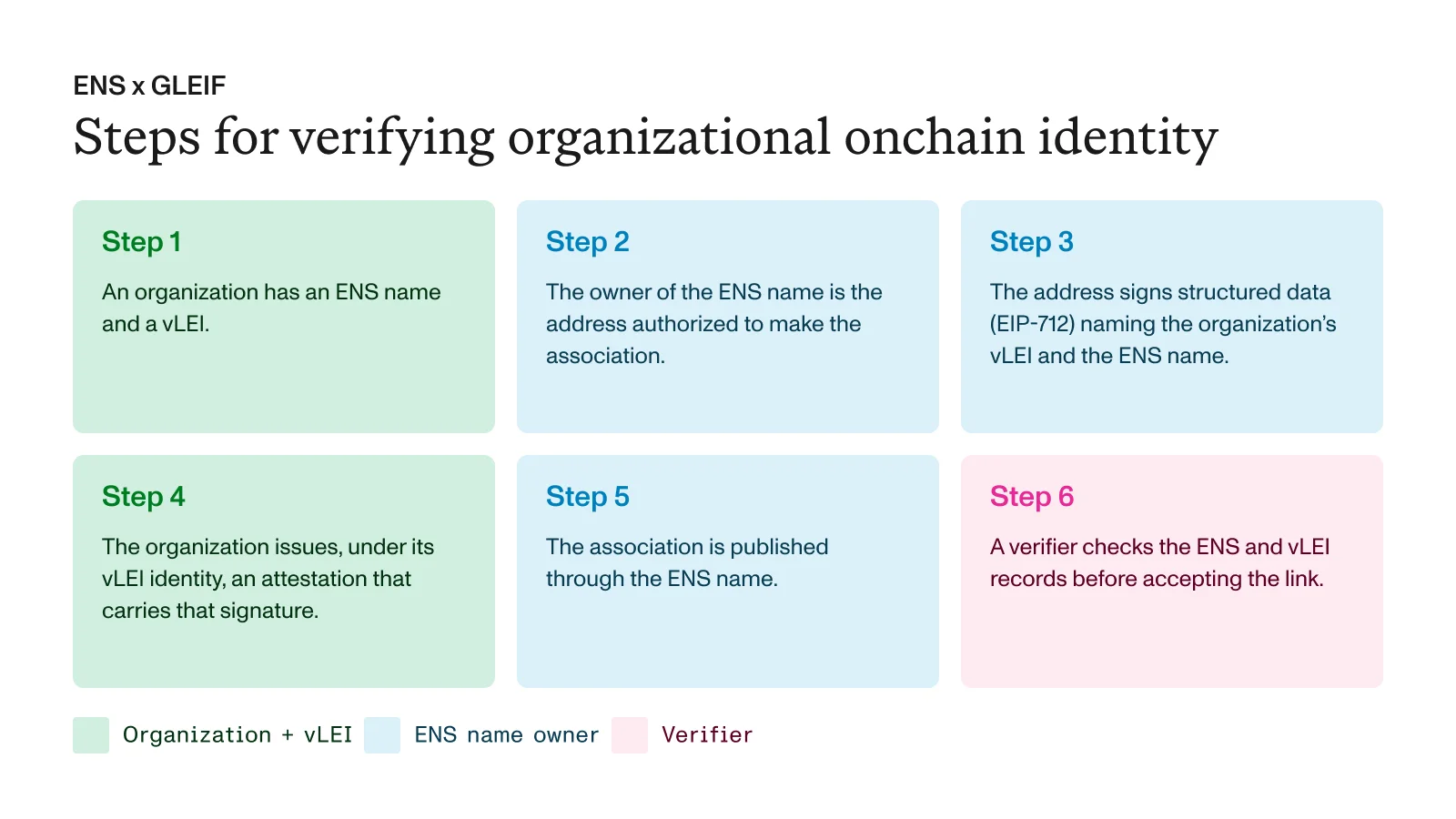
When an ENS name provides the onchain reference and the vLEI provides the organizational identity, an application can verify that both sides authorized the association.
Public blockchain infrastructure can make it challenging to identify an entity from an address alone. A single counterparty may run multiple wallets, deploy across several networks and rotate providers over time. Pairing an ENS name with a vLEI gives institutions a persistent, verifiable reference for who they're actually transacting with, not just which address received the funds.
As institutions tokenize funds, securities and other assets onchain, each issuance needs a clear, trustworthy link back to the entity that stands behind it. An ENS name tied to a vLEI can help a tokenization team establish and maintain one consistent, verifiable identity across every asset and network, even as the underlying infrastructure evolves.
Anyone can deploy a contract or stand up a wallet and claim to represent an organization. Connecting an ENS name to a vLEI moves that claim from unverified assertion to something a counterparty or application can independently confirm, helping address a real gap in how organizations are recognized onchain today.
ENS Labs and GLEIF are continuing to refine the proposed specifications and are engaging with institutions to understand how this approach could be applied in in production environments.
Both organizations will be attending Sibos 2026 to advance the conversation about bringing organizations onchain in a trusted and verifiable manner.
As more of the world comes onchain, ENS is designed to be flexible and open to serve as an infrastructure layer for organizing onchain information, with names that can integrate with the information that matters most for global commerce.