As tokenized assets spread across more networks and applications, contract addresses alone aren't enough to show which versions are official or where their current information lives. ENS can give each asset a durable, issuer-controlled profile.
Tokenized assets have been discussed for years. Lately, the conversation has accelerated and technology has moved into production.
Franklin Templeton and HashKey recently expanded access in Asia to the Franklin OnChain U.S. Government Liquidity Fund, grBENJI. Tokenized U.S. Treasury and money market funds have grown 15x in two years, reaching $15 billion. On Base, Coinbase and Chainlink are connecting tokenized stocks to pricing infrastructure that can support lending, borrowing, and other DeFi use cases. Tokenized equities reached $2.3 billion by mid-July 2026.
These are different products serving different markets, but they point in one direction. Assets that once existed inside separate financial systems are becoming global as onchain building blocks. As those assets move between exchanges, wallets, custodians, lending markets, and other applications, there needs to be a way for market participants to keep track of what each token represents and which version of it can be trusted.
This is a problem that ENS is built for: a shared reference point for tokenized markets.
The tokenized asset market is beginning to connect products that were previously confined to separate systems. Funds are being distributed through digital asset platforms. Tokenized stocks are moving into lending markets. The same asset may eventually need to work across several chains, applications, custodians, and trading venues.
Contract addresses will remain essential, but they are a difficult foundation for a market that expects many different systems to recognize the same asset. Issuers and platforms need a durable way to organize their products, while applications need a reliable way to find the latest information about them.
ENS can provide that shared reference point through open, readable namespaces controlled by the organizations responsible for the assets. It does not need to decide which assets are legitimate or maintain a central list of everything that exists. Issuers and platforms publish information within their namespaces, and applications choose which namespaces they trust and use.
That gives ENS a clear role in the tokenized asset stack: the registry layer that connects an asset's identity to the contracts, records, and systems built around it.
Onchain systems generally identify tokenized assets by their network and contract address. That tells an application where one deployment lives. As an asset expands to new networks, is wrapped by different platforms, or moves to a new contract, those addresses multiply while the underlying asset remains the same.
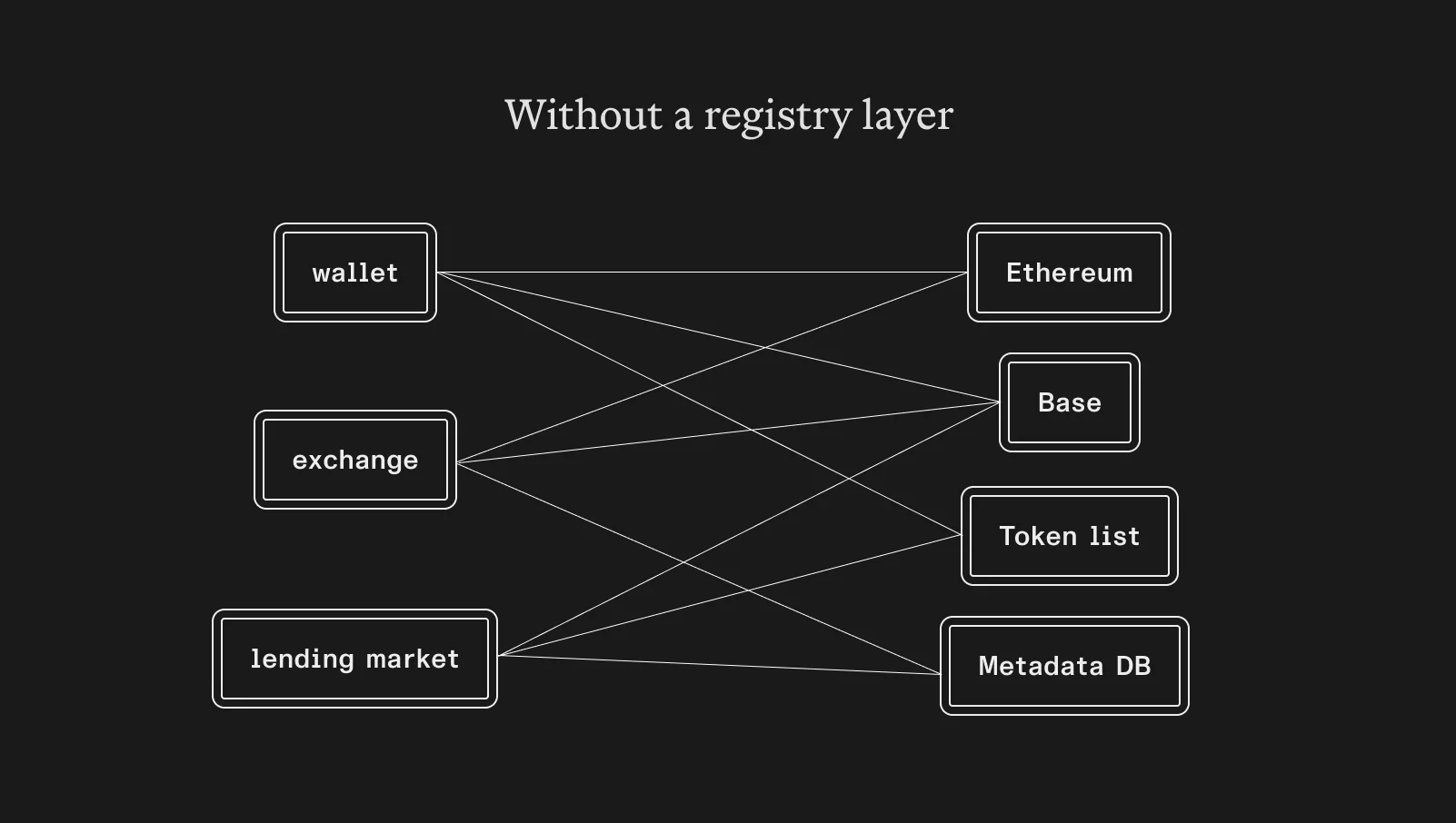
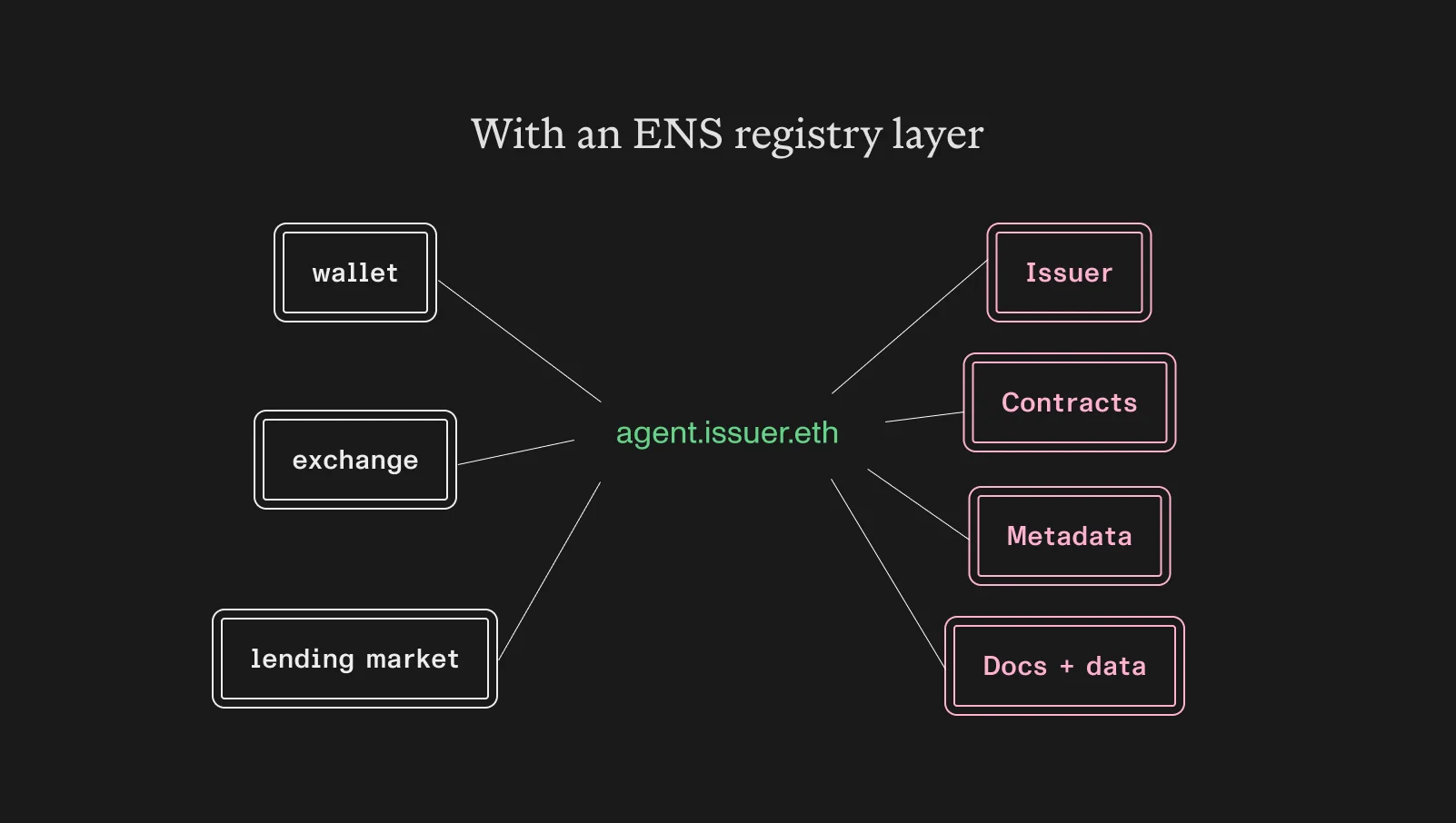
An ENS registry could connect those deployments to a single named asset profile. Applications could resolve the name to find the contracts, issuer information, metadata, and documentation associated with the asset, rather than building and maintaining those mappings independently.
Without a shared registry, each integration has to piece this information together separately. That creates redundant work and increases the risk of applications relying on incomplete or outdated information, especially as tokenized assets become available across a wider onchain ecosystem.
ENSv2, which is currently in beta, makes this model more useful for organizations managing large or complex product ranges. Its hierarchical registry architecture allows each name to have its own registry for the names below it, enabling any asset issuer to create a taxonomy system for their entire collection of tokenized assets.
An issuer could organize its namespace around the structure of its business: organization, product family, individual asset, and network deployment. A tokenization platform could also operate a broader registry for the issuers and assets available through its service.
With an ENS name, issuers retain control over how their assets are organized and can decide who is authorized to manage and update the information associated with them.
That flexibility is particularly useful for institutional assets, which often involve issuers, administrators, custodians, and other service providers. ENS can reflect those existing relationships while giving each party the appropriate level of control.
For tokenization platforms, this would enhance the product they offer issuers. With ENS, a platform could create and manage an official namespace for the assets it supports and give other applications a dependable way to identify those assets outside the platform itself.
ENS would sit alongside the other systems involved in bringing an asset onchain. Pricing would still come from oracle infrastructure. Custody, settlement, and transfer restrictions would remain with the relevant providers. For digital assets that require specific risk management protocols, this can still be maintained through existing systems. ENS can provide those systems a common way to identify the asset and find the information associated with it.
A name could act as the entry point to a complete profile for the asset. It could resolve to the relevant contract or contracts, while its associated records could identify the issuer, ticker, asset class, underlying asset, supported networks, token standard, eligible investor type, key service providers, and official documentation. The RWA.xyz profile for MUon shows the kind of information asset directories already bring together today.
Fast-changing information such as NAV, token supply, holder count, and transfer volume wouldn't necessarily need to be stored directly in ENS. The asset profile could point applications toward the issuer's approved data sources or feeds instead. Wallets, exchanges, custodians, and protocols would then have a consistent place to begin when identifying an asset and retrieving its current information.
Defining a shared set of records would be an important part of making this useful in practice. The profile would describe the asset and the organizations responsible for it, without needing to connect individual investors to their holdings. This would make tokenized assets easier to identify, evaluate, and integrate across applications.