
ENSv2 will introduce updated .eth pricing, including an $8 annual base price for 5+ character names and new multi-year discounts across all name lengths. It will also shorten the grace period from 90 to 28 days, with a 62-day expiration adjustment for existing names that upgrade to preserve their previous grace-period end date.
Following a DAO vote earlier this year, ENS will introduce a set of updates to .eth name pricing and expiration mechanics as part of ENSv2.
The annual fee for 5+ character names will increase from $5 to $8 and a new multi-year discount structure will be introduced across all name lengths. In parallel, the grace period will move to a 28-day window.
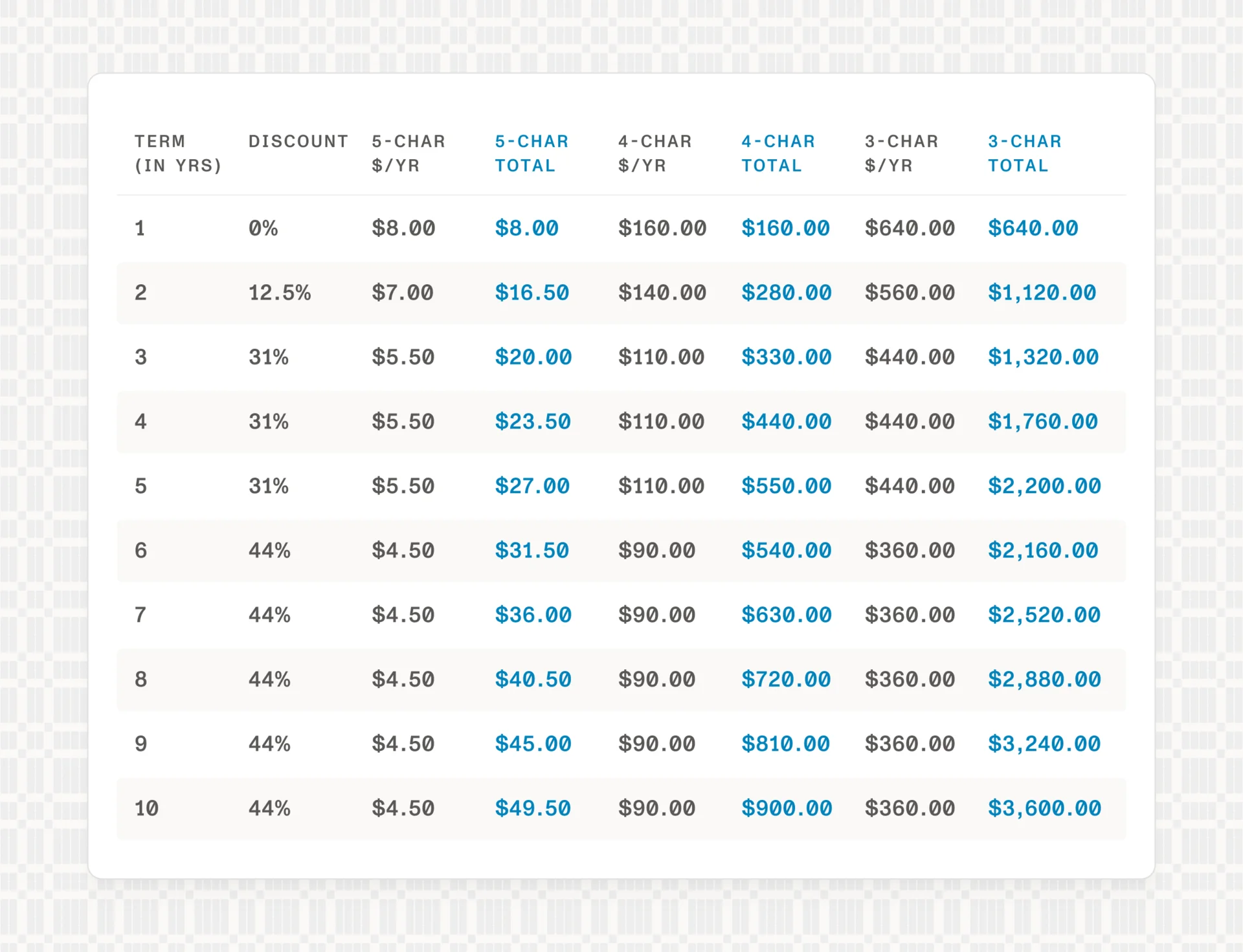
These changes are meant to optimize for long-term retention through significant discounts based on registration length and ensure the namespace remains healthy as ENS continues to grow.
ENSv2 marks a natural point to revisit the incentive structures that shape name ownership. Pricing and grace periods are two of the core mechanisms that shape how names are owned and used. Pricing defines the cost of ownership, while the grace period defines how ownership ends and how names return to circulation.
This post is intended to clarify what is changing, why, and what it means in practice.
Before getting into specifics, it's worth being clear about why these two areas matter and how they fit into the broader protocol.
As outlined in the ENS Constitution, the primary purpose of registration fees is to discourage speculative registration. A secondary purpose is to fund ongoing development of the protocol. In practice, pricing determines who can participate in the namespace, how much of it is actively used versus passively held, and how sustainably ENS can continue to invest in improvements. With changes, we see churn to be healthy for the name ecosystem, as it allows for new users to enter and claim their desired name. Getting the price right across a wide range of users is one of the more delicate balances the protocol has to strike.
The grace period acts as a safety net. If a user misses a renewal, it provides a fixed window to renew the name before it becomes available to others.
The two mechanisms are tightly linked. Pricing sets the cost of holding a name while the grace period defines how quickly unused names return to circulation. When they are well calibrated together, the result is a namespace that is stable for active users, accessible to new ones, and resistant to long-term hoarding.
These changes went through several rounds of public discussion before being approved in an ENS DAO social vote. Feedback from delegates and name holders shaped the final proposal, including the new annual price for 5+ character names, the multi-year discount structure, and the 28-day grace period.
Annual registration prices on .eth currently break down as follows:
- 3-character names: $640 per year
- 4-character names: $160 per year
- 5+ character names: $5 per year
These prices have remained unchanged since the early days of .eth, when the priority was minimizing friction for new users.
Over the last seven years the protocol has matured considerably, with ~905,000 .eth names and ~34 million subnames registered and integrations across wallets, social apps, and enterprise platforms.
ENSv2 provides a natural opportunity to revisit whether the current pricing model still reflects how the namespace is used today.
The headline change is that 5+ character names will move from $5 to $8 per year. 3- and 4-character base prices are unchanged.
Alongside that, a new multi-year discount curve applies to all names. The curve has three tiers, with 1-year registrations serving as the baseline from which all discounts are measured:
- Starter Tier (2 years): 12.5% off
- Committed Tier (3-5 years): ~31% off
- Long-Term Tier (6+ years): ~44% off
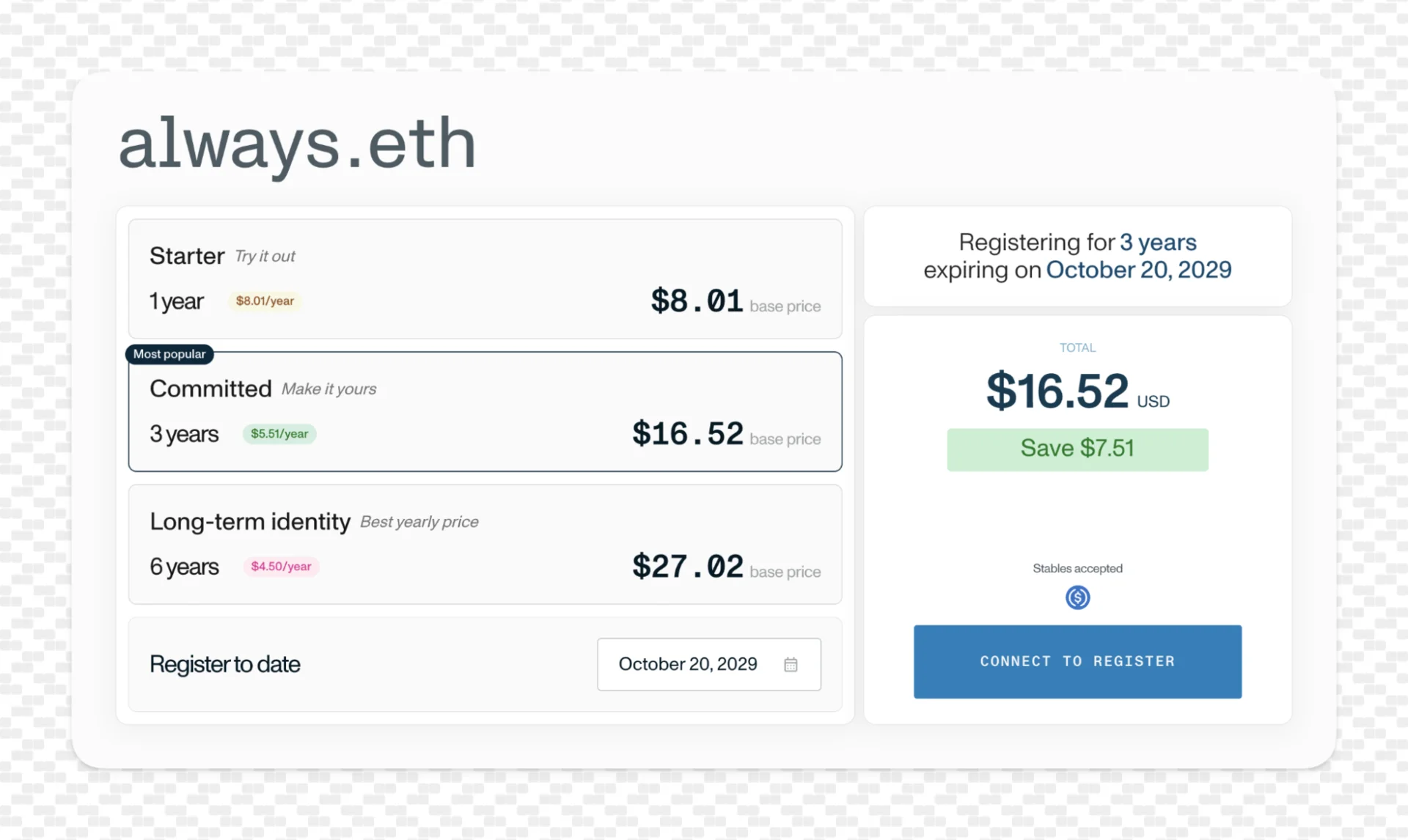
For example, adding five years in one transaction receives the five-year rate; if you later add another three years, that renewal receives the three-year rate. Each duration therefore maps to a single, predictable price at the point of registration or renewal.
The structure is designed to make longer registration and renewal terms more economical on a per-year basis. The more years you add in a single registration or renewal transaction, the lower the effective annual price, whether you're registering a new name or extending one you already own.
Before and after, in practice
To make the change concrete, here is how common scenarios compare:
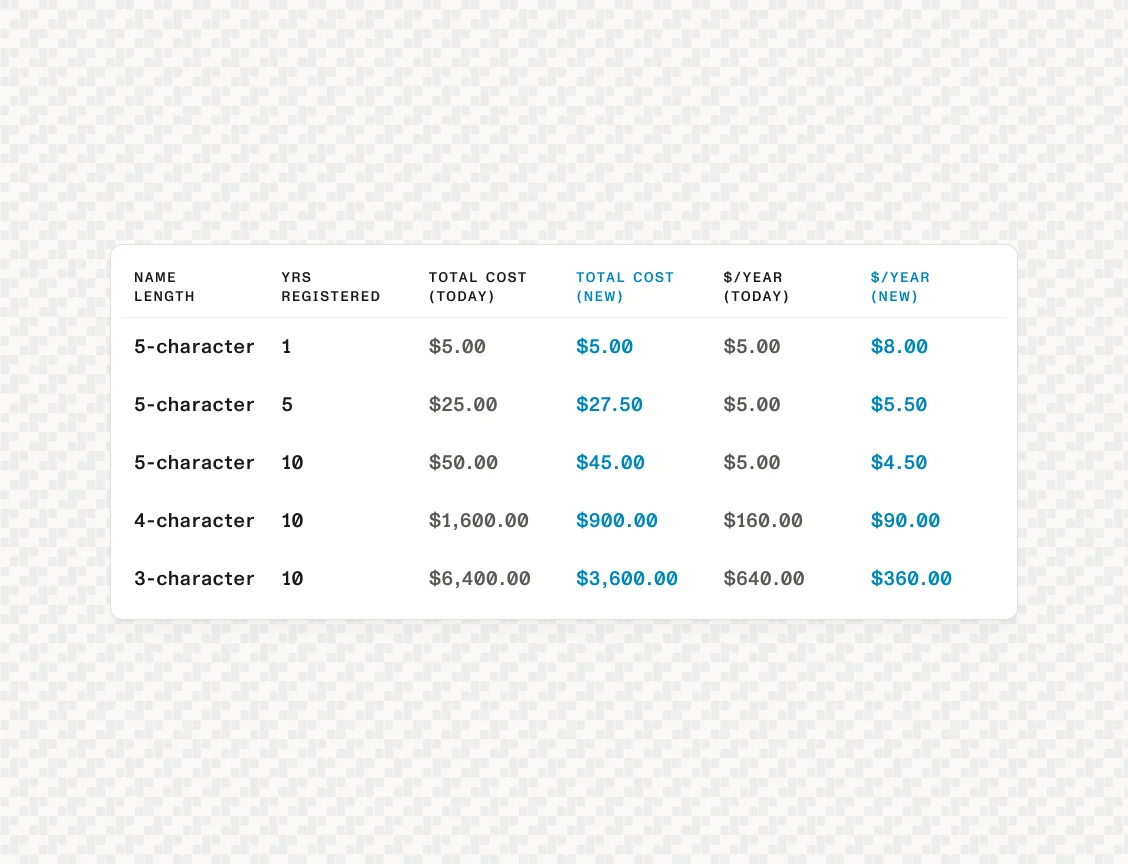
Users who renew one year at a time will pay modestly more for 5+ character names. The goal in doing so is to make long-term ownership more economical.
The second change this post covers is to the grace period.
When an ENS name's registration expires today, it enters a 90-day grace period. During grace, the name continues to resolve and its records can still be edited, but it cannot be transferred or registered by anyone else. The original owner can renew at the normal annual price at any point during those 90 days. After the grace period ends, the name is released and enters the temporary premium period, where anyone can register it at a gradually decreasing premium on top of the normal price. Under the current system, its existing records can continue to resolve until the name is registered again.
Under ENSv2, the grace period evolves into a shortened and clearer form.
- The grace period is capped at 28 days.
- During grace, the name appears as expired. It is not resolvable, not transferable, and cannot be modified.
- The name can be recovered during this window by renewing at the normal annual price.
- After 28 days, the name enters the 21 day price cooldown, where an additional premium drops exponentially over that time to $0. Premium is paid in addition to base price. If no one registers during this time, it becomes available at normal base price.
To account for the change from a 90-day grace period to a 28-day grace period, 62 days are added to an existing name's expiration date when it upgrades to ENSv2. This preserves the same grace-period end date the name would have had under the previous system, so upgrading does not bring forward the point at which it enters the price cooldown period.
The practical implications are straightforward.
For users who miss a renewal, there is still a clear window to recover the name. ENS will surface expiration through the App and supported notification channels, while a name no longer resolving is itself a visible signal that it has entered grace. The safest approach is still to keep names you care about renewed well in advance. With the new multi-year discounts, renewing for longer also reduces the effective annual cost.
For the broader namespace, the shorter grace period means expired names return to circulation more quickly. Names that are genuinely no longer wanted do not linger in an ambiguous state for a prolonged period of time, and names that are wanted can be renewed within the window.
For anyone navigating the namespace, the visual state of an expired name during grace is unambiguous. Expired means expired, in the UI and in resolution.
Before and after, in practice
- A name expires on day zero.
- Before: The name enters a 90-day grace period. It continues to resolve and its records can still be edited, but it cannot be transferred. After 90 days, it enters the temporary premium period.
- Going forward: The name enters a 28-day grace period. It no longer resolves, cannot be transferred, and its records cannot be edited. After 28 days, it enters the price cooldown period.
- A user wants to recover the name on day 20.
- Before: register at the normal price.
- Going forward: register at the normal price. No change for the typical recovery case.
The most meaningful change for name holders is that the window for recovery is shorter. In exchange, the system's state is clearer, and the incentive to keep a name you care about in good standing is sharper.
One takeaway from this update is that pricing should evolve alongside the protocol. What made sense in earlier stages of ENS may not reflect how the namespace is used today.
The base registration prices for .eth names have remained unchanged since May 2019, more than seven years ago. Going forward, the DAO will review pricing on a biennial basis to assess whether the fee structure continues to serve its intended purpose: discouraging speculative registration while providing sufficient funding for the ongoing development and improvement of ENS.
These updates are a step toward keeping price and grace period mechanisms well-calibrated for where ENS is today, while leaving room for them to evolve alongside the protocol. The DAO's biennial review will give the community a regular forum to revisit those questions together.
The pricing and grace-period changes described here have already received approval through an ENS DAO social vote. The DAO is now voting on the executable proposal to activate ENSv2, which will bring these changes into effect alongside the broader protocol upgrade.
As ever, the underlying intent is unchanged: keep ENS accessible, keep the namespace healthy, and make sure the people who take a name and put it to use are the ones who benefit most.