
Naming systems are often treated as simple usability features, but their role runs much deeper. Shared names allow systems to coordinate around identities, services, and networks without relying on central directories. As ENS evolves, it is becoming more than a way to label addresses. It is emerging as the foundational coordination layer for identity across the internet.
Every large digital system eventually encounters the same coordination problem.
People, applications, and services need a way to refer to one another using shared identifiers. Without a unifying reference layer, systems fragment quickly. Different applications maintain their own directories, users juggle incompatible identifiers, and integrations become fragile.
The internet solved this problem through naming systems. DNS allows billions of devices to refer to the same websites. Package registries allow developers to depend on shared software libraries. Domain registries maintain global namespaces that remain consistent across the web.
Decentralized networks face the same challenge.
As blockchain ecosystems expand across multiple networks, users and applications still need a way to refer to identities in a consistent and portable way. ENS was originally introduced to make contract addresses readable, but its role has steadily expanded beyond that initial use case.
Today ENS is evolving into the identity layer for the internet. Once a naming system reaches enough adoption, it begins to function less like a feature and more like essential infrastructure.
Many of the systems that make the internet usable operate in the background.
DNS is one of the clearest examples. Most users experience DNS as a translation layer that turns domain names into IP addresses. What often goes unnoticed is that DNS also serves as a global coordination system.
It ensures that when millions of devices refer to the same domain name, they are all referring to the same destination. Without that shared agreement about names, the web would quickly fragment into incompatible references.
This pattern appears throughout digital infrastructure. Software ecosystems rely on package registries so developers can refer to shared libraries by name. Certificate authorities coordinate trust for secure connections. Domain registries maintain namespaces that allow websites to exist without colliding with one another.
Each of these systems answers the same fundamental question. When someone refers to a name, what exactly does it point to?
Decentralized systems must answer the same question, but they do so without relying on centralized directories.
Traditional internet systems rely heavily on central registries to keep identities and references consistent. Platforms maintain user databases, organizations control domain namespaces, and infrastructure providers publish authoritative registries.
Blockchains enhance many of these coordination points. This design strengthens neutrality and censorship resistance, but it also introduces a practical challenge. Even without central operators, the ecosystem still needs ways to agree on identities and references.
In practice, applications maintain their own mappings between names and addresses. Developers implement custom resolution logic. Users manage multiple identifiers across wallets, networks, and interfaces. The result is fragmented coordination across systems.
As the ecosystem grows, this fragmentation becomes more visible. The more independent systems exist, the more important it becomes for them to share consistent references.
Naming systems solve this problem.
A naming system provides two essential properties.
First, it gives humans a readable way to reference digital entities. Second, it ensures that those references resolve consistently across different environments.
With a standardized naming system, applications can rely on common identifiers instead of maintaining their own parallel mappings. Users can carry their identity across interfaces without constantly reintroducing themselves through new addresses or handles. Protocols can refer to one another using stable references that do not depend on a single application's internal database.
The effect of this coordination becomes clearer through examples that have already emerged across the ecosystem.
When a user sets vitalik.eth as their identity, that name becomes portable across wallets, applications, and social interfaces. Instead of each application maintaining its own identifier for the same person, the ecosystem can coordinate around a shared reference.
Infrastructure projects use ENS in a similar way. The security tool Revoke.cash registered revoke.eth and tied it directly to a product that protects users across hundreds of networks. The name does more than provide a readable address. It anchors the identity of the service itself across wallets, interfaces, and integrations.
In both cases, ENS is providing a shared reference point that allows different parts of the ecosystem to recognize the same entity.
This is how naming systems become essential infrastructure.
Since launching in 2017, ENS has become one of the most widely integrated protocols in the blockchain ecosystem. Approximately 1.6 million domains and 30 million subnames now exist across wallets, applications, exchanges, and developer tools.
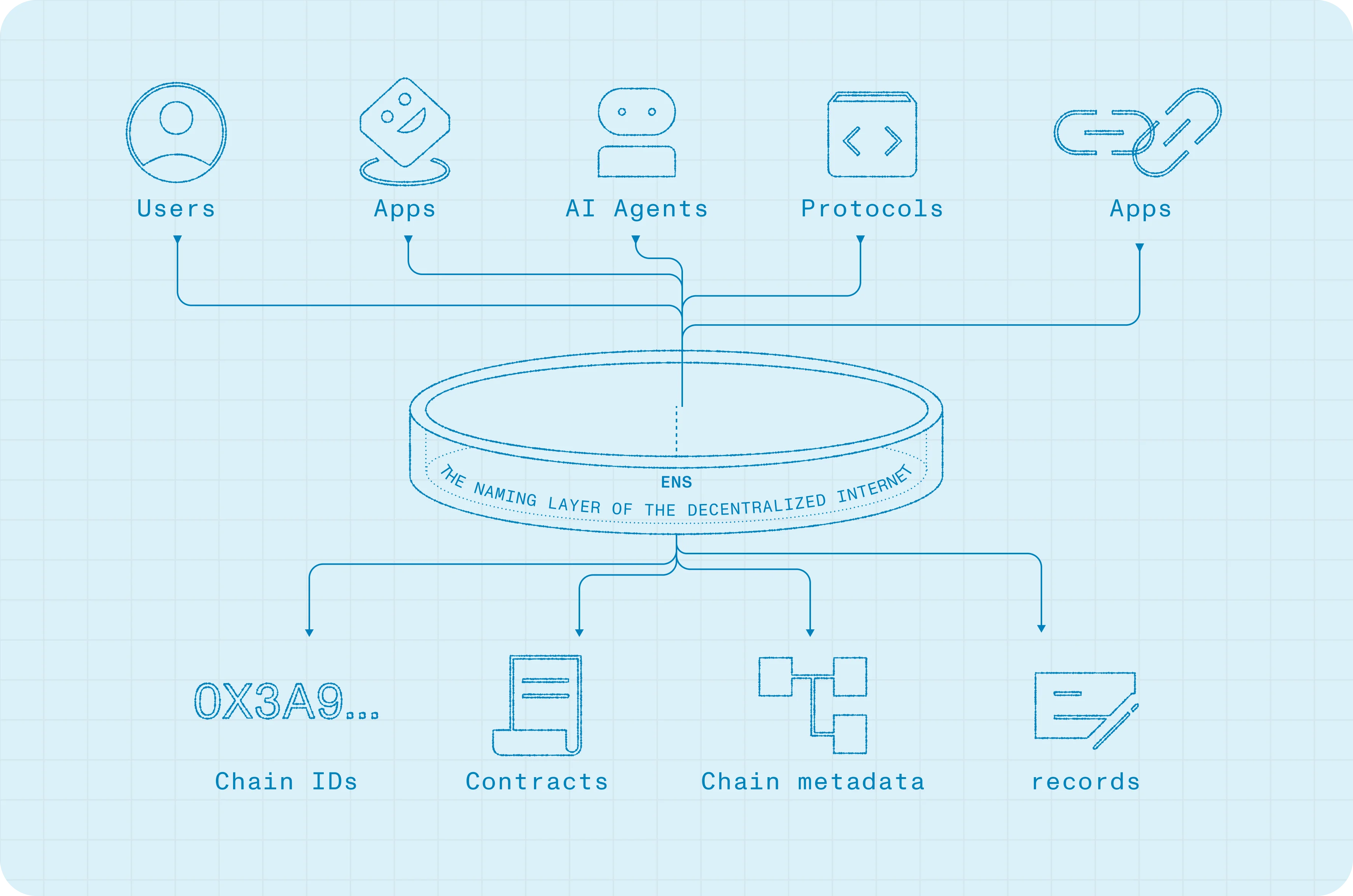
At a surface level, ENS allows users to replace wallet addresses with human-readable identifiers. Beneath that surface, ENS provides something more powerful. It offers a shared namespace that allows the ecosystem to coordinate around identity.
Developers use ENS names to represent users, contracts, and services. Wallets resolve ENS records to display addresses, profile information, and other metadata. Applications rely on ENS to reference accounts across chains and interfaces.
Large platforms have also begun using ENS to structure identity systems for their own ecosystems. Coinbase's base.eth namespace, for example, allows users to receive simple subnames tied to their accounts. Instead of onboarding new users through raw addresses, networks can coordinate around human readable identifiers that remain compatible with the broader ecosystem.
Because ENS operates across 100+ chains, these integrations accumulate rather than fragment. Each new integration increases the usefulness of the namespace for everyone else.
What begins as a naming layer gradually becomes a shared identity standard.
The evolution of ENS continues with ENSv2, which introduces a new architectural foundation for how names are managed and resolved.
One of the most important shifts is toward a hierarchal registry structure. This change allows each name to define its own ownership rules and namespace structure. Organizations can manage entire trees of subnames, applications can create structured identity systems, and communities can coordinate around shared namespaces.
At the same time, ENS is expanding the range of identities it can represent.
Work such as the on.eth chain registry allows networks to publish verifiable metadata within ENS. Identifiers like vitalik.eth@base combine an ENS name with a chain reference, allowing identities to resolve across different execution environments.
These developments extend ENS beyond simple address resolution. They position ENS as the coordination layer capable of translating identities across users, applications, and networks.
Identity systems are often described as product features. In decentralized systems, they are infrastructure.
Without shared naming standards, every application must construct its own identity model. References between systems become disconnected, and users must navigate a growing landscape of incompatible identifiers.
ENS provides an identity standard that any application can build on. Instead of each platform maintaining its own identity directory, the ecosystem can coordinate around a shared set of names that resolve consistently across any interfaces and networks.
As decentralized systems expand across chains and applications, having a shared identity coordination layer becomes increasingly important. The ability to refer to users, services, and networks through stable identifiers creates a common language for the entire ecosystem.
Seen in this light, ENS is not simply a naming service.
It is essential infrastructure that allows existing systems and decentralized systems to coordinate around identity.
And as that coordination surface expands, the role of ENS will continue to grow alongside it.