
ENS is more than the App or a .eth registration flow: it is an open naming protocol designed to work across wallets, apps, gateways, marketplaces, and independent interfaces.
For most people, ENS begins with a product.
You open the App, search for a name, register it, and connect it to an address or profile. Or you first encounter an ENS name somewhere else: inside a wallet, on a marketplace, or when someone sends you a name instead of a long hexadecimal address.
All of these are ways of using ENS, but they rely on the same underlying protocol. That distinction helps explain why a name can work beyond one interface, how developers can build new experiences around it, and why ENS was designed as shared infrastructure from the start.
ENS began at the Ethereum Foundation, where early work on Swarm, a decentralized storage project, raised a familiar problem.
The system could locate information, but the identifiers it used were designed for machines. People needed a human-readable way to find, recognize, and share what was stored there.
The internet had already solved a version of this through the Domain Name System, or DNS. Instead of asking someone to remember an IP address, we give them a domain name. Ethereum needed a similar naming layer: one that could connect human-readable names to addresses, content, identities, and other information.
That idea became the Ethereum Name Service.
Today, ENS names can point to Ethereum addresses, addresses on other networks, content hashes, profile information, and other records. The system can also work in reverse, allowing an address to point back to a primary name.
The ENS documentation describes it as a distributed, open, and extensible naming system. That last part is central to the idea. ENS was not designed to predict every possible use of a name, but to provide a shared foundation that users, applications, and developers could continue building on.
The goal was not only to create a website where people could register .eth names, but instead, a naming system that could work across applications and, over time, across the entire internet.
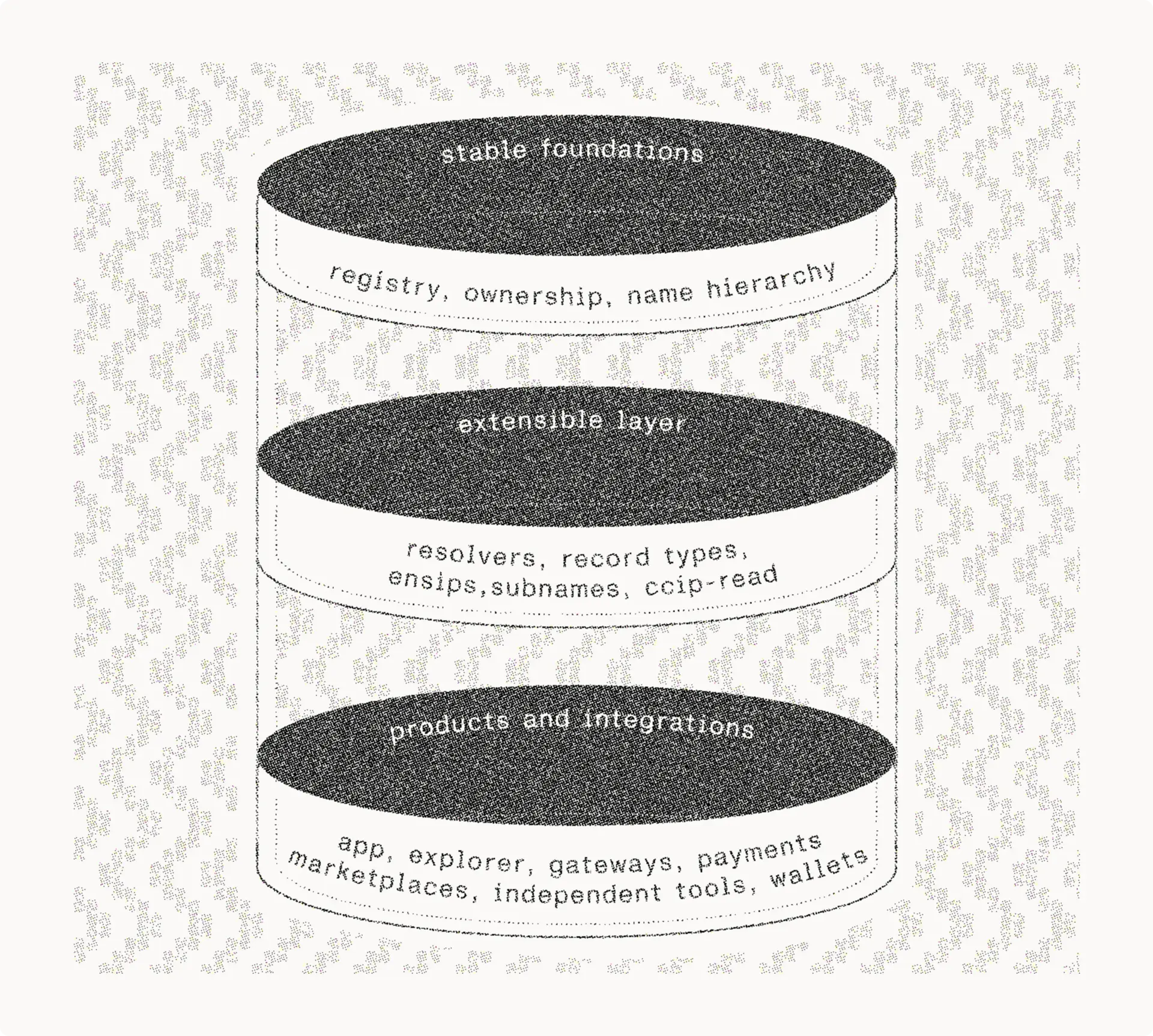
"ENS" is often used to describe several connected but distinct things: the protocol, the .eth namespace, the App, the Explorer, and the wider ecosystem around them.
At the core is the ENS protocol: the contracts and standards that allow names to be created, controlled, configured, and resolved.
ENS is most closely associated with .eth, its native top-level domain, but the protocol is not limited to .eth names. DNS names can also be brought into ENS, allowing existing internet names to connect with onchain addresses and records.
Names also need to resolve. Resolution is the process of finding the information connected to a name. A resolver might return an Ethereum address, an address on another network, a content hash, an avatar, or another record associated with it.
Ownership and resolution are related, but they are not the same thing. The holder controls the name, while its resolver determines which information the name returns. Applications then read that information and decide how to display or use it.
This distinction helps explain what someone controls, what they can configure, and what an application is actually looking up when it encounters an ENS name.
Finally, there are products and interfaces. The App and Explorer, currently in Alpha and moving toward Beta, offer first-party ways to interact with the protocol. Wallets, payment products, marketplaces, gateways, and independent applications create their own experiences around it.
Each layer serves a different purpose. The protocol defines the shared system, namespaces organize names within it, resolvers connect those names to information, and products turn the underlying system into something people can use.
A protocol is useful only if people know what they can depend on.
A developer integrating ENS expects a name to resolve consistently. A name holder expects clear rules around control and renewal. Applications need shared standards that do not change unpredictably beneath them.
That stability is part of what makes a protocol worth building on. As more independent applications trust ENS enough to integrate it, the protocol becomes more useful to everyone who holds a name.
But stability cannot mean freezing the system in place.
Names are already being used in ways that were not anticipated when ENS first launched, and new needs will continue to emerge. The protocol has to support new records, resolution methods, namespaces, and applications without undermining the guarantees people already rely on.
Different parts of ENS are designed to evolve at different speeds. The foundational logic around names and ownership changes slowly, while resolvers and standards can support new functionality in a more additive way. A client that does not understand a new record type can continue using the records it already supports.
Because ENS is permissionless, new ideas do not need to originate from one team or wait for approval before they are built. Developers can experiment with new record types, resolver profiles, subname standards, cross-chain resolution methods, and other extensions on their own. The ENS Improvement Proposal process exists to document and standardize additions that are useful for the wider ecosystem, so more applications can understand and support them.
This allows ENS to grow without requiring every application to change at once or rebuilding the base naming system each time a new use case appears.
The balance between stability and extensibility reflects the principles that have shaped ENS from the beginning: user control, predictable ownership, open integration, interoperability, and long-term utility.
Some expectations are enforced directly by the protocol, while others are commitments that guide how ENS evolves. Name holders rely on the protocol's rules around control, renewal, and resolution. The ENS Constitution adds governance-level commitments around the system's long-term direction, including ENS's goal of integrating with the global DNS namespace as widely as possible without sacrificing decentralization.
For name holders, that means clear and predictable rules around controlling, renewing, and configuring a name. For developers, it means being able to integrate ENS through open standards rather than relying on permission from a central operator. For product teams, it means reducing complexity without making a name dependent on one application or interface.
This reflects an ambition that goes beyond making blockchain addresses easier to read. ENS is working toward an open naming layer that allows people to control a name and use it across different applications, communities, and parts of the internet.
Maintaining that balance still requires ongoing work. Contracts need to be designed, audited, deployed, and improved. Standards require careful review, documentation needs to stay accurate, products need continued development, and integrations need support.
Being open does not mean the work happens by itself. It means more people can inspect the system, propose new ideas, contribute to its development, and build on the same foundation.
A protocol can do a great deal and still be difficult to use. Products are what make its capabilities accessible.
The App is built to make registering, managing, and using names more approachable. It focuses on the actions people actually need while keeping much of the technical complexity in the background.
The Explorer serves a different purpose. It surfaces more of the protocol's detail, allowing users and builders to inspect control, resolution, history, contracts, and configuration.
The App makes ENS easier to use, while the Explorer makes it easier to understand. They are complementary products built for different users of ENS.
Because both are still being tested as part of ENSv2, feedback can shape more than the interface. What the team learns about registration, pricing, name management, and other parts of the experience can also inform the infrastructure supporting them.
The protocol provides the shared foundation. Products make that foundation usable.
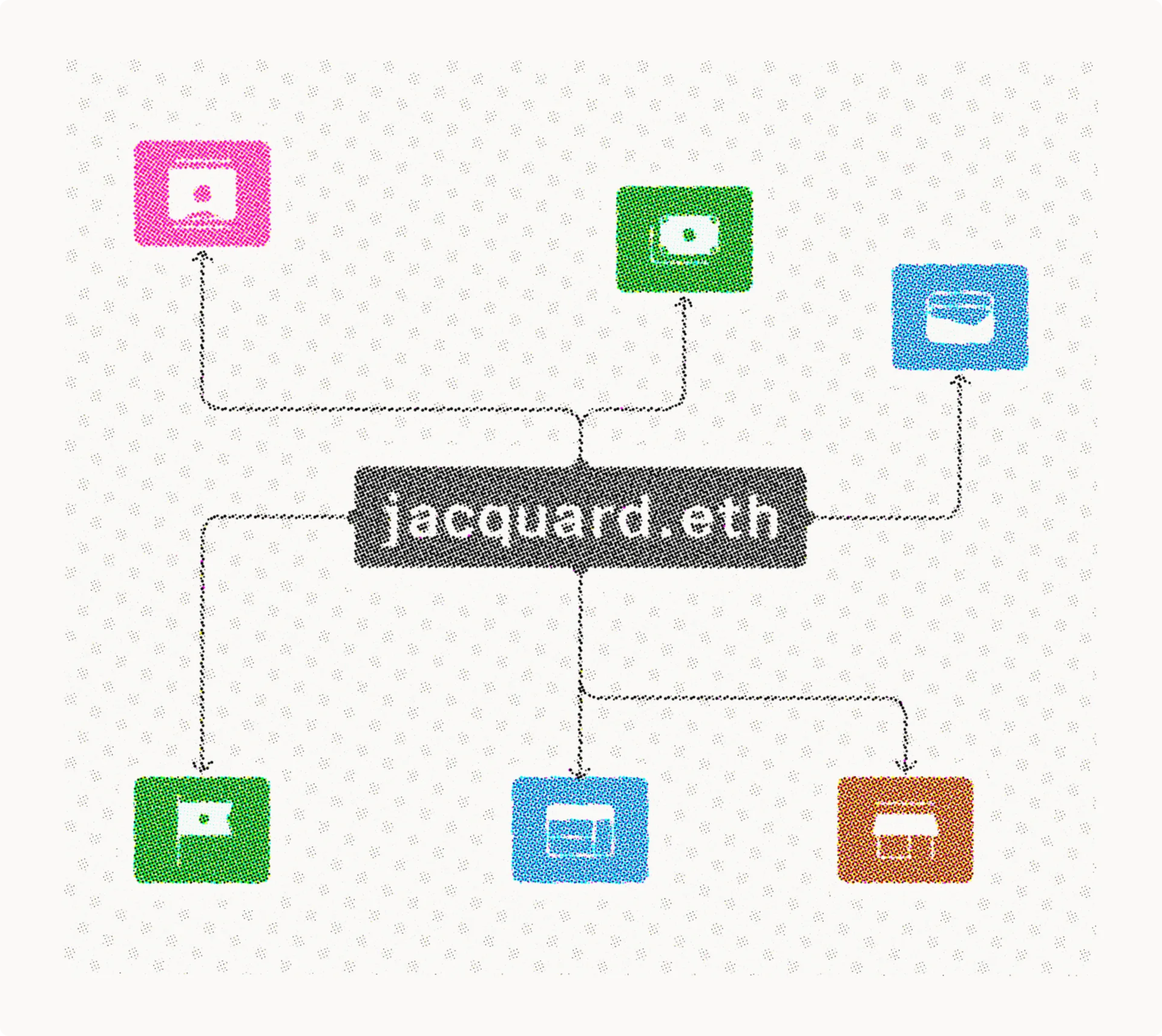
The App and Explorer are first-party products, but they are not the only ways ENS can be used.
A wallet like MetaMask can resolve a name instead of displaying an address. A payment product like PayPal can use ENS to help identify a recipient. A marketplace like ENS Vision can build experiences around discovering and trading names. A gateway like eth.limo can use ENS names to help people access content. Independent builders can also create their own tools, apps, and experiments around the protocol.
Each interface serves a different purpose, but they all draw from the same shared system.
This is possible because ENS is built around open standards. Its contracts, libraries, documentation, applications, and technical specifications are publicly available. Builders can integrate the protocol without needing a private agreement or approval process.
They can resolve names, display records, support new standards, create resolvers, or develop their own interfaces. The same openness that allows contributors to extend the protocol also allows applications to interpret it in different ways.
This makes a name more useful. Rather than being confined to the product where it was registered, the same name can be understood across wallets, applications, communities, and services. Each integration gives people another place to use it.
Openness does not mean an absence of structure. It means the rules are visible, the standards are shared, and others can build on the same foundation.
It also makes it important to distinguish first-party products from independent interfaces, which ENS does not necessarily operate or endorse.
The real value of ENS becomes clear when a name continues to work beyond the place where it was registered. A wallet can resolve it, a payment app can use it, a profile can carry across services, and a compatible browser or gateway can use it to find content. Most people should not need to understand every contract or resolver involved. They should be able to rely on their name behaving as expected, remaining under their control, and being understood by the applications they use.
Products make that experience approachable, but the protocol gives it continuity. By keeping its foundations stable, allowing new functionality to be added through open standards, and giving many different applications a common language for names, ENS can become infrastructure rather than a destination. That is the larger ambition: a naming layer open enough to evolve, dependable enough to build on, and useful wherever people choose to carry their names.