
ENSv2 moves from a single flat registry to a hierarchical system where each name has its own registry. This unlocks powerful new capabilities like flexible ownership models, fine-grained permissions, and improved multi-chain support, and requires a comprehensive tool to get deep visibility into the ENS protocol.
Today we're launching the alpha ENS Explorer, the primary source of truth for ENS. This is a new, comprehensive tool, created for builders, power users, and anyone who needs deep visibility into the ENS protocol. The Explorer is built for transparency, surfacing every detail of the ENS protocol, its names, and its contracts.
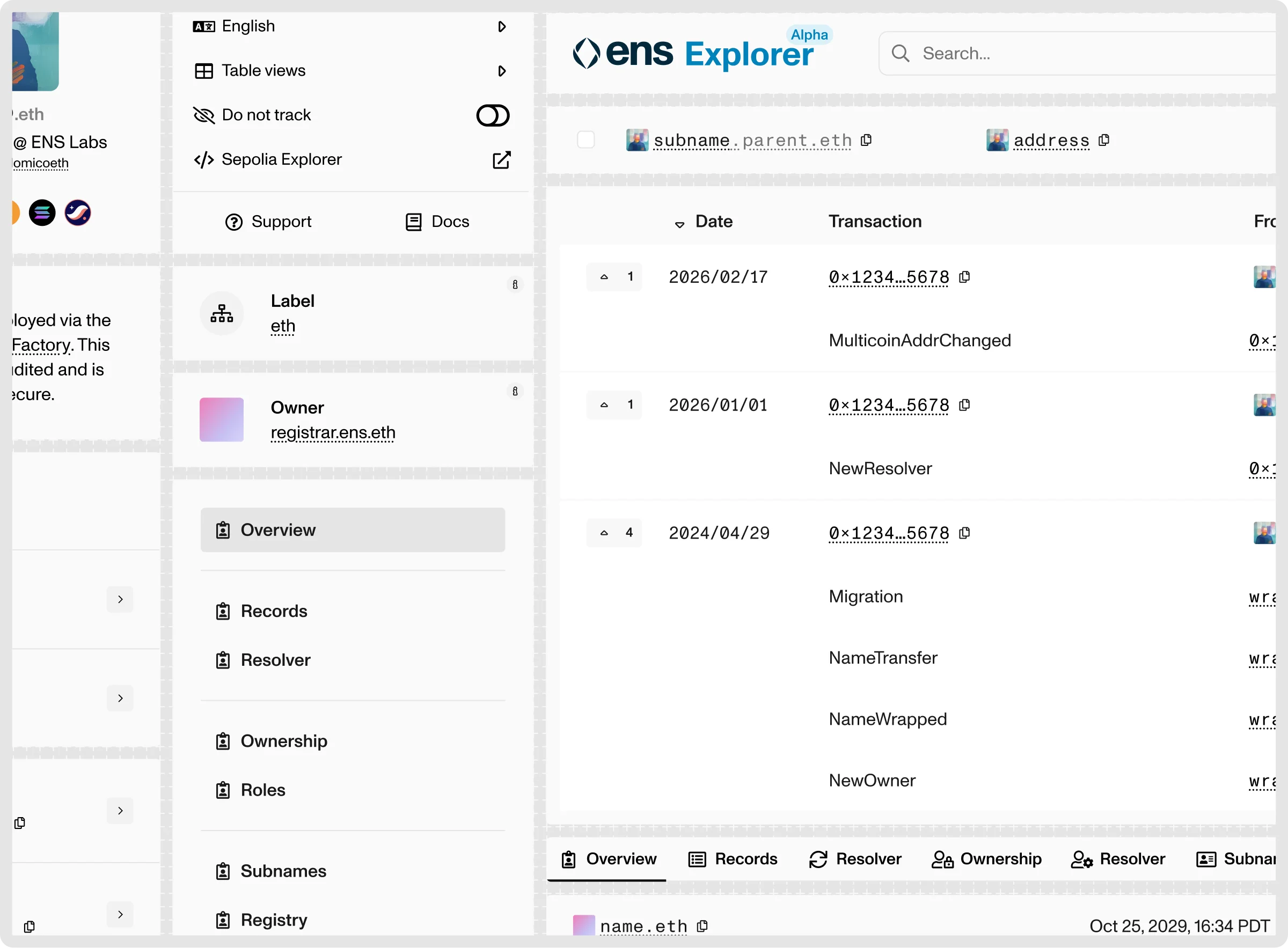
At the moment it's very hard to interrogate the ENS protocol and the depth of complexity that it contains. This hinders builders and technical users by abstracting away information that is useful for building and innovating on ENS. It also makes it more complicated for users to identify what has happened to their names, and by whom.
In addition, ENSv2 introduces a new registry architecture that the legacy ENS Manager simply wasn't designed to handle. ENSv2 moves from a single flat registry to a hierarchical system where each name has its own registry. This unlocks powerful new capabilities like flexible ownership models, fine-grained permissions, and improved multi-chain support.
The ENS Explorer is unapologetically transparent, designed to get out of the way of technical users. This gives us the opportunity to cover new areas that were otherwise too complex for most users:
- Native ENSv2 support, with comprehensive support for new registries, resolvers and roles.
- Role management, giving users full control over the new roles systems in ENSv2.
- Historical information on all names, with full event history for ENS and granular filtering and search.
- Backwards compatibility, with all the same transparency and history for all ENS versions.
The ENS Explorer designed to operate independently of ENS Labs infrastructure. Even if our servers cease to exist, the Explorer can continue functioning by reading directly from the Ethereum blockchain, hosted on IPFS. It's also built as a general purpose tool that will always work with ENS contracts, including legacy ENSv1.
Building ENS Explorer this way is a commitment to ENS's core values of decentralization and permanence. Your source of truth for ENS data will persist as long as Ethereum does.
The ENS Explorer Alpha is now available on Sepolia testnet. Like the ENS App, this is a true alpha: we're actively developing features, refining the information architecture, and incorporating feedback. Right now the UI is still in wireframe, so expect significant visual enhancements soon.
In the coming weeks, we'll be adding:
- Expanded subname creation and management tools
- Robust record management tools
- Dedicated registry views
- Complex registration options
- Performance optimizations and design improvements
We Want Your Feedback
This alpha phase is crucial for getting Explorer right. This is a first version, so all feedback is welcome, including the features that are present, missing, confusing or helpful. We'd love to know what tasks do developers need to accomplish, and how can the Explorer better support them. Share your idea and complaints using the Feedback button in the app.
The ENS App and ENS Explorer represent two sides of the same coin. The App hides complexity to make ENS accessible; the Explorer reveals it to make ENS transparent. Together, they serve the full spectrum of our community—from first-time users claiming their identity to developers building the next generation of web3 infrastructure.
Both applications connect to the same decentralized protocol. Your choice of tool doesn't change what ENS is; it changes how you interact with it.
Try the ENS Explorer Alpha → https://explorer.ens.dev/ Is your application ready for ENSv2? → https://docs.ens.domains/web/ensv2-readiness/ Join our Telegram Channel for updates → https://t.me/+oA8H5nF5GpI1ODA5