Today, ENSv2 is live on Ethereum mainnet. We've rebuilt the protocol and the experience around it for the people who rely on ENS today, and for everything that will need a name in the years ahead.
For many of us, our first ENS name became part of how we showed up onchain. It was where someone sent us a payment, how other people recognized us, or a name we chose to build a reputation around. Over time, builders took that same idea and put it to work across entire communities and applications. The names people chose became part of the infrastructure people built.
ENSv2 carries that story forward. It introduces a new architecture to usher in the next era of onchain naming. For everyone who has helped ENS reach this point, today is a significant moment, and one we've been looking forward to sharing with you.
The new ENS App is designed for everyday users. It gives people a clearer way to register and manage their names. Registration has been redesigned to feel like a single action, while the App brings renewals, profile customization and notifications into the everyday experience of using ENS. Someone getting their first name can start here and understand what they can do next.
The new ENS Explorer is designed for people building the future of onchain infrastructure. It gives builders and experienced users a closer look at what's happening at the protocol level. They can inspect a name's history, see who controls it, understand how it resolves and examine its configuration. Where the App helps people use their names, the Explorer helps them see how those names work.
The protocol underneath them has changed, too. ENSv2 introduces hierarchical registries and more precise permissions, updates how names are resolved across the new structure, and lets names share records through linking.
The App, Explorer and protocol have been shaped through public Alpha and Beta testing. Since Beta, the focus has been on refinement, security fixes and preparing them for production. Today, they come together on mainnet.
The mainnet release also extends beyond the ENS App and Explorer. Wallets, applications and infrastructure providers have been preparing for ENSv2, with a focus on supporting more of what ENS already offers, including offchain names, primary names, profiles and smart accounts. These integrations help people use their names across the products they already rely on and give builders a stronger foundation for what comes next.
Personal names were how many people first came to know ENS. When ENS launched in 2017, a name like alice.eth offered a recognizable way to interact with an Ethereum account. It was easier to remember and share than a long address. As wallets and applications integrated ENS, people could carry that name with them into more places, and for many it became part of their identity online and in real life.
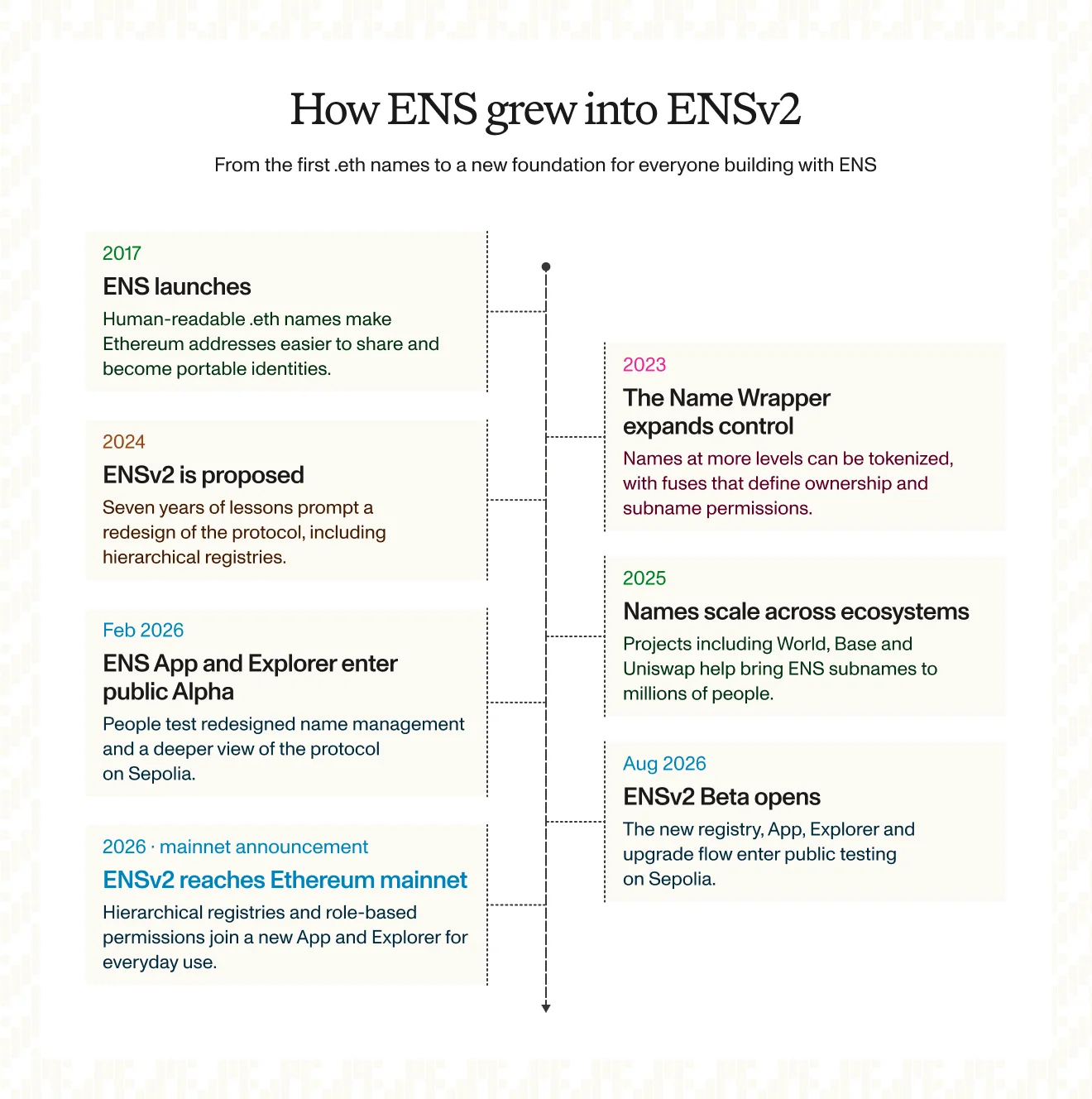
Builders then began putting names to work across their own communities and applications. Base, Uniswap and World are among the projects that have furthered naming experiences on ENS. Someone might now encounter their first ENS name through a product or community they're already part of. The same open protocol that supports an individual's .eth name can support names across an entire ecosystem.
Today, ENS supports over 36 million names across .eth and ecosystem namespaces. ENS names are only as useful as the 600+ applications that support name resolution, from DeFi apps like 1inch, Jumper and Lighter; wallets like MetaMask and Safe; and infrastructure providers like Aragon and Arbitrum. This scale calls for a protocol that can serve a person managing one name, a community issuing names to members and an organization coordinating names across teams and products.
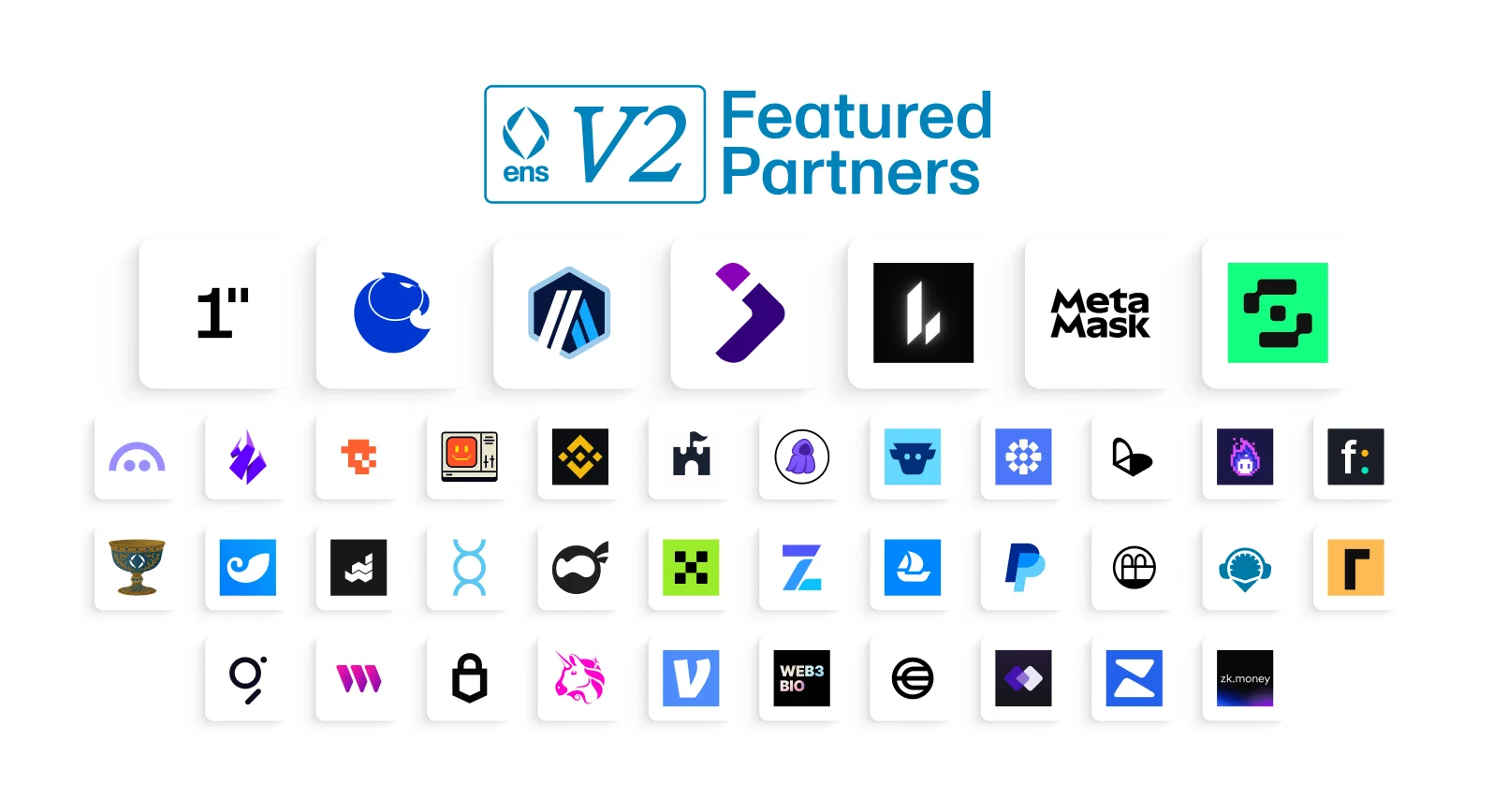
Featured Partners: 1inch, Aragon, Arbitrum, Jumper, Lighter, MetaMask, Safe Aave, Ambire, BankrBot, Binance Wallet, BuidlGuidl, Cloaked, CowSwap, Doma, eth.limo, Firefly, Freedom Browser Grails, imToken, Jaw.ID, Mt Pelerin, Namespace, OKX Wallet, Open Zepplin, OpenSea, PayPal, Privacy Pools, Remix.Live, Revoke.Cash The Graph, Thirdweb, Trezor, Uniswap, Venmo, Web3.bio, World, Yodl Pay, Zerion, zk.money
The Name Wrapper gave builders a richer ownership layer and more detailed permissions on top of ENSv1. Those additions also made the original architecture more complex to manage. ENSv2 brings what we've learned into the foundation of the protocol.
With hierarchical registries, an individual name can now serve as its own onchain registry. A community can decide how it issues names to members; a company can organize names around its teams and products. ENSv2's permissions model lets them authorize someone to manage one part of a namespace without handing over control of everything else. Builders can set rules that fit what they're making while remaining part of the wider ENS namespace.
Tokenized assets offer one example of where this could lead. The same asset may have contracts on several networks and information held across different systems. An issuer could organize its products under names it controls and connect each name to the contracts, documentation and other details that applications need to find. Those applications would still decide which issuers and information they trust.
As blockchains connect with more existing systems, there will be more people, organizations, assets, entities (human or agent), and services that need to be identified across them. ENSv2 gives builders more flexibility in defining how those names are organized and managed. That's what we mean by naming everything: extending the usefulness people already find in their own names to what they're building around them. ENS is open infrastructure, providing the flexible foundation to empower anyone to build the naming infrastructure they need.
Your existing ENS name will continue to work. You don't need to register it again to keep using it. ENSv2 also provides a path to upgrade your .eth name when you're ready to use the new capabilities. Starting today, you can upgrade your names to ENSv2 directly in the ENS App.
We're also marking the launch with an ENSv2 commemorative NFT collection. Created by Simon, also known as Polyhop, each generative card reflects its holder's history with ENS. Eligible holders can reveal their card in the ENS App after upgrading all their eligible names, then claim one NFT per wallet. The claim requires an Ethereum transaction, so network gas fees apply.
ENS has grown because people kept finding new things to do with a name. You put names into wallets, built communities around them, and made them part of your lives online. Contributors across the ecosystem helped develop and test the protocol, asked difficult questions, and showed us where it needed to improve. Thank you for helping bring ENSv2 here.
Today, we get to put that work in your hands. Whether you're choosing your first name or building something that needs a million of them, we're excited to see what you do with ENSv2. There's a whole world left to name.